Fig. 2
Formwise
A drag-and-drop form builder.
A 90-second walkthrough with narration and captions. Sound plays only when you press play.
The problem
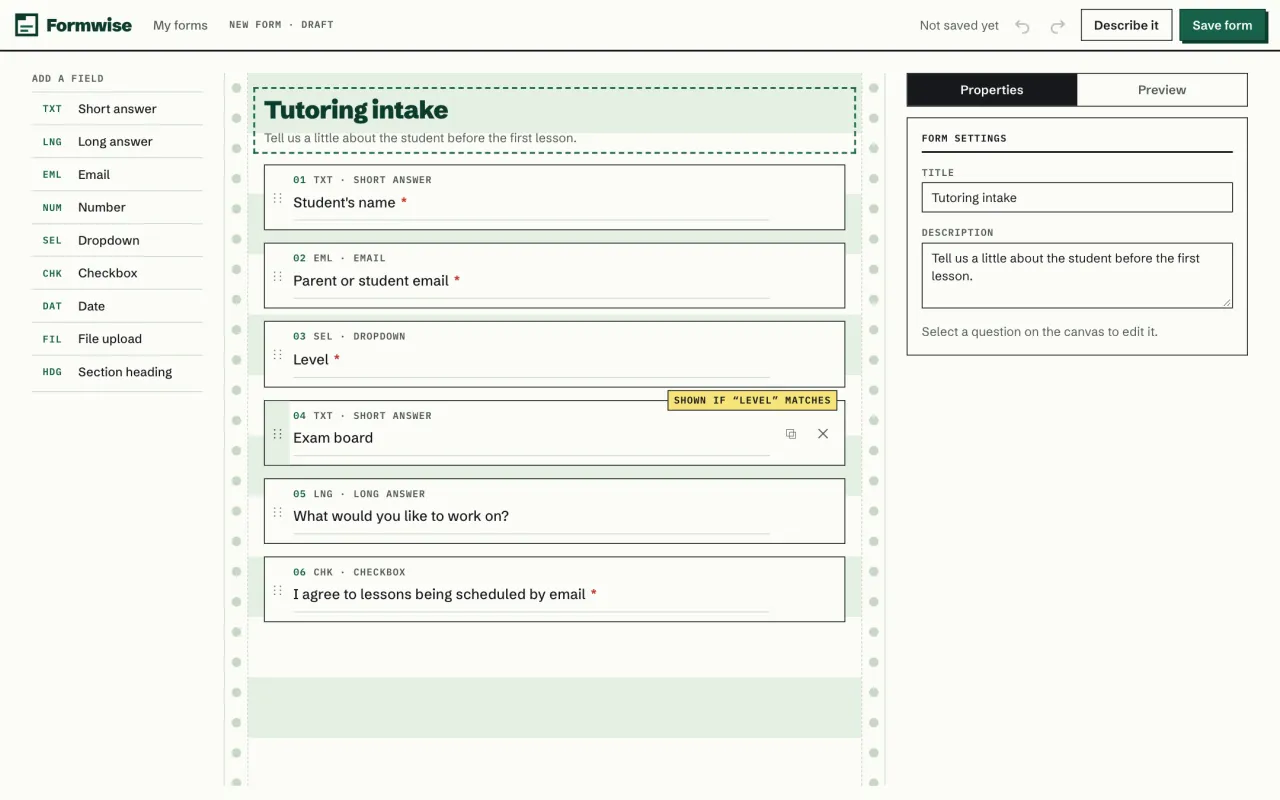
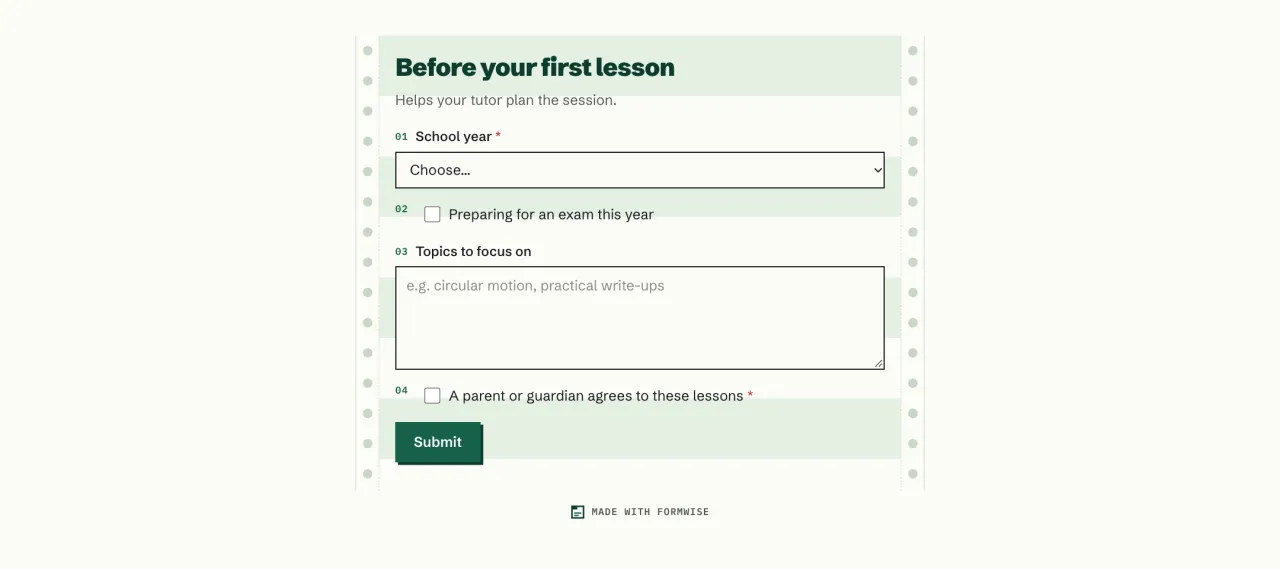
A simple intake form often means a heavy form tool or hand-written code. Formwise lets you drag questions onto a page, add show-if rules and publish a link, with no account. Or describe the form and edit Claude’s draft.
For small teams that need intake or sign-up forms, and for apps that embed them, like Slotwise.
The product
Hard problems
Edits that can’t break the form
Moving or deleting a question can break a show-if rule that points at it. Every edit is a command run through one pure reducer. When an edit breaks a rule, the reducer removes it and the builder says which question lost it. A property test applies 300 random edits and checks the form is still valid after each.
One set of rules everywhere
The builder preview, the public form, the API and Slotwise all check answers with the same two functions from one shared package. A form can’t pass in one place and fail in another. Each answer records the form version it was given against, so publishing a change never rejects someone who is halfway through.
AI output treated as untrusted input
Claude fills a small draft format through structured outputs. The server turns the draft into a real form and validates it like any import. If that fails, the exact errors go back to the model once. Descriptions are length-limited and rate-limited per address, with a daily cap.
How it’s built
- Vite and React, Zustand, dnd-kit
- Hono API on Vercel Functions
- Postgres on Neon, Drizzle ORM
- Zod schema, shared renderer package
- Claude Opus 5.5 with structured outputs
- Vitest with PGlite, Playwright
More decisions and their trade-offs are in the README.
Replies within a working day.
Need something like this?
Email meNext: Docwise, aI extraction of supplier invoices, with every value audited.
Sources
- “Describe your form” on Claude Opus 5.5: 8 of 8 descriptions returned a valid form. End to end from India to the US region, median 4.45 s, range 2.91–7.67 s. Measured 15 Oct 2026. Source: formwise-builder/docs/measurements.
- Formwise builder, Lighthouse mobile: performance 98, accessibility 100, LCP 1.8 s. Median of 3 runs, Lighthouse 12.8.2, measured 14 Oct 2026 from India against production. Source: formwise-builder/docs/measurements.
- Formwise tests as of 15 Oct 2026: 140 Vitest tests and 16 Playwright runs (15 pass, 1 skipped by design on mobile), green in CI. Source: formwise-builder README.